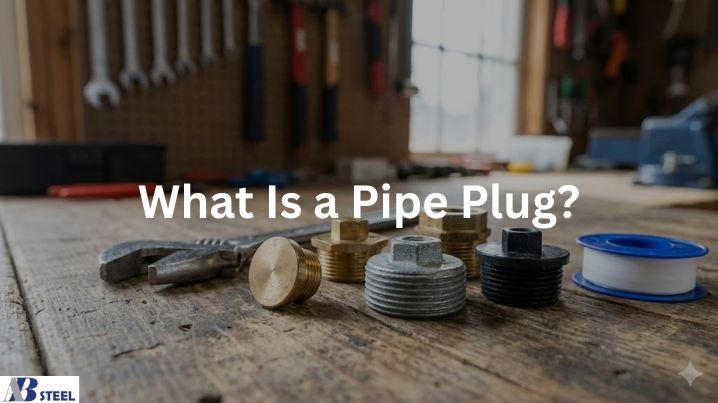
In piping systems, even the smallest components play a critical role in safety and performance. One such essential but often overlooked fitting is the pipe plug. Pipe plugs are widely used across industries to seal pipe ends, unused openings, and threaded connections. At AB Steel, we supply high-quality pipe plugs designed to perform reliably in demanding industrial environments. This blog explains what a pipe plug is, how it works, its types, materials, applications, and why choosing the right pipe plug matters.
Understanding What a Pipe Plug Is
A pipe plug is a solid fitting used to close or seal the end of a pipe or a threaded opening in a piping system. Unlike caps, which fit over the outside of a pipe, pipe plugs are generally inserted into the pipe or screwed into internal threads. Their primary function is to stop the flow of liquids or gases, protect internal threads, and maintain pressure integrity within the system. Pipe plugs are commonly used in permanent installations as well as temporary shutdowns and maintenance operations.
Why Pipe Plugs Are Used in Piping Systems
In industrial piping, not every pipe opening is required at all times. Some ports are reserved for future expansion, inspection points, pressure testing, or instrumentation. Pipe plugs provide a secure and leak-tight way to seal these unused openings. They help prevent leakage, contamination, pressure loss, and corrosion inside the pipe. In high-pressure or high-temperature systems, a properly selected pipe plug is critical for operational safety.
How a Pipe Plug Works
Pipe plugs work by creating a tight mechanical seal within a threaded pipe opening. When the plug is tightened, its threads engage with the internal threads of the pipe or fitting, creating a secure connection. Depending on the application, thread sealants, PTFE tape, or metal-to-metal sealing designs may be used to enhance leak resistance. Once installed, the pipe plug blocks the passage completely, ensuring that no fluid or gas can pass through the sealed opening.
Types of Pipe Plugs Used in Industry
Pipe plugs come in various designs to suit different installation and service requirements. Hex head pipe plugs are among the most common types and are easy to install or remove using a wrench. Square head pipe plugs offer better grip in heavy-duty applications and are often used in high-pressure systems. Socket (internal hex) pipe plugs are flush-fitting and preferred where space is limited or a clean appearance is required. Some pipe plugs are designed specifically for pressure testing or temporary sealing, while others are meant for permanent closure.
Materials Used for Pipe Plugs
The material of a pipe plug plays a major role in its performance and lifespan. Stainless steel pipe plugs are widely used due to their excellent corrosion resistance, strength, and suitability for high-temperature and high-pressure applications. Carbon steel pipe plugs are commonly chosen for general industrial use where strength is required at a lower cost. Brass pipe plugs are preferred in applications involving water, air, or mild chemicals due to their corrosion resistance and ease of installation. The right material ensures compatibility with the piping system and the conveyed media.
Pipe Plug vs Pipe Cap – Understanding the Difference
Pipe plugs and pipe caps are often confused, but they serve different purposes. A pipe plug fits inside the pipe or threaded opening, while a pipe cap fits over the outside of the pipe. Plugs are typically used where internal threading is present, whereas caps are used on externally threaded pipes. Choosing the correct fitting ensures a proper seal and avoids leakage or installation issues.
Installation and Sealing Considerations
Proper installation of pipe plugs is essential to ensure leak-free performance. The threads should be clean and free from damage before installation. Thread sealants or PTFE tape are commonly used to improve sealing and prevent galling, especially in stainless steel plugs. Over-tightening should be avoided, as it can damage threads or make future removal difficult. Correct torque and proper sealing practices help extend the service life of both the pipe plug and the piping system.
Where Pipe Plugs Are Commonly Used
Pipe plugs are widely used in oil and gas pipelines, chemical processing plants, power generation units, water treatment facilities, and hydraulic systems. They are also commonly found in valves, pumps, pressure vessels, and manifolds. In maintenance operations, pipe plugs are frequently used to isolate sections of piping during repairs or system modifications.
Why Choose AB Steel for Pipe Plugs
At AB Steel (absteel.in), we manufacture and supply pipe plugs that meet strict industrial standards for dimensional accuracy, material quality, and performance. Our pipe plugs are designed to handle pressure, temperature, and corrosive environments with reliability. With a focus on quality control and customer-specific requirements, AB Steel ensures dependable solutions for a wide range of piping applications.
Conclusion
A pipe plug may be a small component, but its role in sealing, safety, and system integrity is extremely important. Selecting the right type, material, and size of pipe plug helps prevent leaks, protects equipment, and ensures smooth system operation. With high-quality pipe plugs from AB Steel, industries can achieve long-lasting and reliable piping performance.