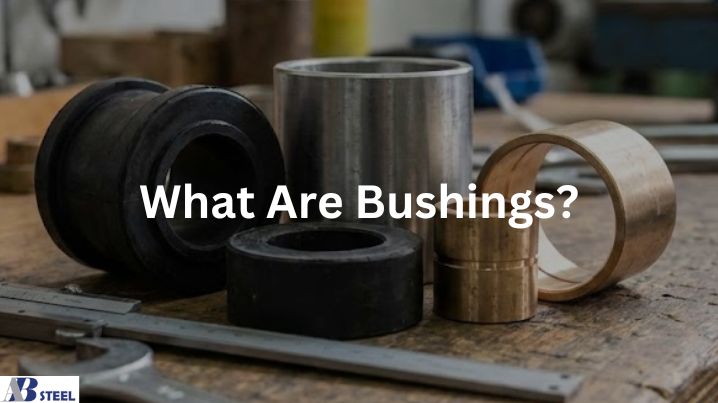
Bushings are one of the most important yet often unnoticed mechanical components used across industries. From heavy machinery and industrial equipment to automobiles and valves, bushings play a vital role in ensuring smooth motion, reducing wear, and extending the life of machines. At AB Steel, we regularly supply precision-engineered bushings for demanding industrial applications, and this guide explains everything you need to know about them in clear, practical language.
Understanding What a Bushing Is
A bushing is a cylindrical mechanical component that is placed between two moving parts, typically a rotating shaft and a fixed housing. Its main purpose is to reduce friction and prevent direct metal-to-metal contact. Instead of allowing the shaft to rub against the housing, the bushing acts as a protective layer that absorbs wear, controls movement, and supports the load. Because of this simple but effective function, bushings are widely used wherever controlled motion is required.
Why Bushings Are Used in Machinery
In any mechanical system, friction is unavoidable. When friction is left unmanaged, it leads to excessive heat, vibration, noise, and premature failure of parts. Bushings help solve this problem by creating a smooth sliding surface that reduces resistance between moving components. They also help distribute loads evenly, accommodate slight misalignment, and absorb shocks during operation. In harsh working environments, bushings protect expensive components by taking the wear themselves, making replacement easier and more economical.
How Bushings Work in Real Applications
When a shaft rotates or moves inside a bushing, the inner surface of the bushing provides a controlled contact area. Depending on the material used, this contact can be supported by lubrication, self-lubricating properties, or a low-friction liner. Over time, the bushing gradually wears instead of the shaft or housing. This design philosophy makes bushings sacrificial components, meaning they are intended to be replaced periodically while protecting more critical and costly parts of the system.
Materials Commonly Used for Bushings
Bushings are manufactured from a wide range of materials to suit different operating conditions. Bronze bushings are among the most popular choices due to their excellent load-bearing capacity and resistance to wear, especially when lubrication is available. Stainless steel bushings are preferred in corrosive environments or where hygiene is critical, such as food processing or marine applications. Polymer and PTFE-based bushings are widely used in dry-running conditions because they offer low friction without the need for lubrication. In vibration-sensitive applications, rubber or elastomer bushings are used to absorb shocks and reduce noise.
Types of Bushings and Their Purpose
There are several types of bushings, each designed for specific mechanical needs. Plain or sleeve bushings are the most common and are used mainly for radial loads. Flanged bushings include a shoulder that helps position the bushing and manage axial movement. Split bushings allow easier installation and replacement without removing the shaft, which is especially useful during maintenance. Thrust bushings are designed to handle axial loads, making them suitable for applications where components experience push or pull forces along the shaft axis.
Bushings Compared to Bearings
Bushings are often compared with rolling bearings, but both serve different purposes. Bushings are simpler in design, more compact, and better suited for heavy loads at low speeds. They also perform well in dirty or high-impact environments where bearings may fail. Bearings, on the other hand, are ideal for high-speed and high-precision applications but require proper alignment and cleaner conditions. In many industrial systems, bushings are chosen because of their durability, cost-effectiveness, and tolerance to harsh operating conditions.
Installation and Maintenance of Bushings
Proper installation plays a major role in the performance and life of a bushing. The housing must be clean, accurately machined, and correctly sized to ensure a proper fit. Press-fitting is commonly used to secure bushings in place, and care must be taken to avoid deformation during installation. Maintenance depends on the bushing material. Some bushings require regular lubrication, while self-lubricating bushings operate with minimal maintenance. Regular inspection helps detect wear early and prevents damage to surrounding components.
Where Bushings Are Commonly Used
Bushings are found in a wide range of industrial applications, including pumps, valves, compressors, gearboxes, construction equipment, and automotive systems. They are also widely used in agricultural machinery and material handling equipment, where reliability under heavy loads is essential. Because of their versatility, bushings are considered a foundational component in modern mechanical design.
Why Choose AB Steel for Bushings
At AB Steel, we understand that every application has unique requirements. We supply high-quality bushings manufactured with strict quality control, precise tolerances, and industry-compliant materials. Whether you need standard bushings or application-specific solutions, our team supports customers with technical guidance, reliable supply, and consistent product performance.
Conclusion
Bushings may appear simple, but their role in protecting machinery and ensuring smooth operation is critical. Choosing the right bushing material, type, and installation method can significantly improve equipment life and reduce maintenance costs. With the right expertise and quality products from AB Steel, bushings become a reliable solution for long-term mechanical performance.