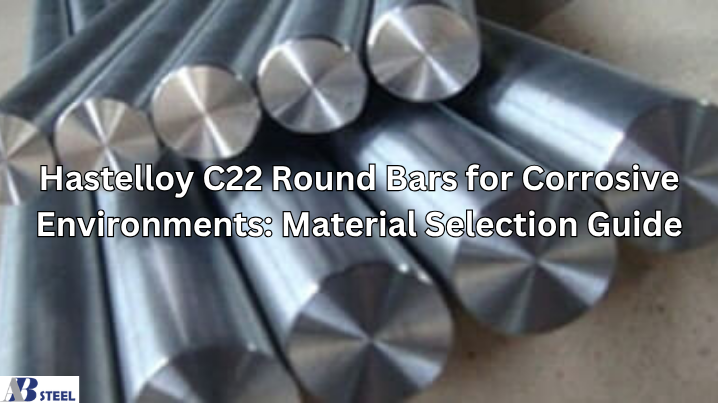
Aggressive chemical processing environments require materials that can withstand more than one type of corrosion. Hastelloy C22, identified as UNS N06022, is a nickel-chromium-molybdenum-tungsten alloy developed for demanding corrosive conditions. Its resistance to pitting, crevice corrosion, and stress-corrosion cracking makes it suitable for applications where exposure can vary during service. However, material selection should still consider the specific chemicals, temperatures, concentrations, and operating conditions involved. These factors help determine whether Hastelloy C22 Round Bars are the right fit for a particular component.
Why Hastelloy C22 Is Used in Corrosive Environments
The alloy’s performance traces directly back to its composition. Chromium supports resistance in oxidizing environments, forming a protective layer that holds up under acidic and oxidizing chemical attack. Molybdenum contributes resistance against reducing conditions and localized corrosion, addressing a different failure mode than chromium alone can handle. Tungsten adds further support against aggressive environments, rounding out an alloy built to perform across a wider chemical range than most single-mechanism materials manage.
Corrosion Resistance of Hastelloy C22
General corrosion resistance is where C22 built its reputation, handling a genuinely demanding range of chemical environments that would degrade lesser alloys quickly. That said, no alloy resists every chemical condition equally well, and C22 is no exception. Selecting it for a specific application still requires confirming performance against the actual process media involved rather than assuming broad resistance covers every scenario.
Resistance to Pitting and Crevice Corrosion
Localized corrosion behaves differently from general surface attack, concentrating damage at a specific point rather than degrading a component evenly. Pitting and crevice corrosion tend to develop in chloride-containing or otherwise aggressive environments, often at gaps, joints, or stagnant flow areas where standard alloys break down fastest. Resistance to these specific failure modes matters as much as general corrosion resistance when a material has to survive in service, since a component can fail locally long before it shows any broad surface degradation.
Performance in Oxidizing and Reducing Environments
Many industrial processes don’t stay in one clean chemical category, cycling between oxidizing and reducing conditions or blending both within the same system. C22 gets considered for exactly these mixed conditions, since its alloying elements address both oxidizing and reducing corrosion mechanisms rather than favoring one at the expense of the other.
Consider Temperature and Service Conditions
Chemical concentration, operating temperature, exposure duration, pressure, and overall process conditions all interact rather than acting independently, which means evaluating them together matters more than checking any single factor in isolation. A concentration that’s manageable at one temperature can become considerably more aggressive at another, so material selection needs to reflect actual service conditions rather than a generic assumption about the chemical involved.
Fabrication and Specification Requirements
C22 round bar machines, forms, and welds using standard nickel alloy procedures, though each process benefits from experience specific to high-performance alloys. Dimensions and material documentation should reference ASTM B574/ASME SB574 and UNS N06022 where applicable, confirming the bar meets its stated specification before it enters fabrication.
Where Hastelloy C22 Round Bars May Be Used
Chemical processing, pollution control, power generation, marine, pulp and paper, and waste treatment industries all draw on C22 where standard alloys fall short of the corrosion resistance required.
How to Select Hastelloy C22 Round Bars
Selection works best as a sequence: start with the corrosive medium involved, then confirm chemical concentration, operating temperature, and localized corrosion risk. From there, mechanical requirements, fabrication needs, and dimensions narrow the specification further, with material documentation confirming the bar actually meets ASTM B574/UNS N06022 requirements before it ships. Buyers evaluating Hastelloy C22 Round Bars should work through this sequence rather than selecting on reputation alone, since the right material choice depends entirely on matching alloy properties to actual service conditions.
Conclusion
Hastelloy C22 round bars earn their place in demanding corrosive service through a genuinely broad resistance profile, covering oxidizing, reducing, and mixed chemical environments along with strong resistance to localized corrosion. That breadth doesn’t make the alloy universally correct for every application, which is why service conditions, chemical exposure, and mechanical requirements all deserve careful evaluation before specifying it. Working through corrosive medium, temperature, localized corrosion risk, and fabrication needs together gives engineers and procurement teams a reliable path to the right material decision, and AB Steel supplies certified C22 round bar backed by the documentation that verification process depends on.