Standard stainless steel fails fast in aggressive chemical service. Pitting starts within weeks in chloride-rich streams, and wall thickness drops before scheduled maintenance notices. Hastelloy C276 foil holds up where these failures occur, resisting oxidizing acids, reducing acids, and chloride attack in the same operating cycle. Plants that switch to this foil see fewer unplanned shutdowns, longer inspection intervals, and equipment that keeps its dimensional tolerance through years of exposure to corrosive media.
What Is Hastelloy C276 Foil?
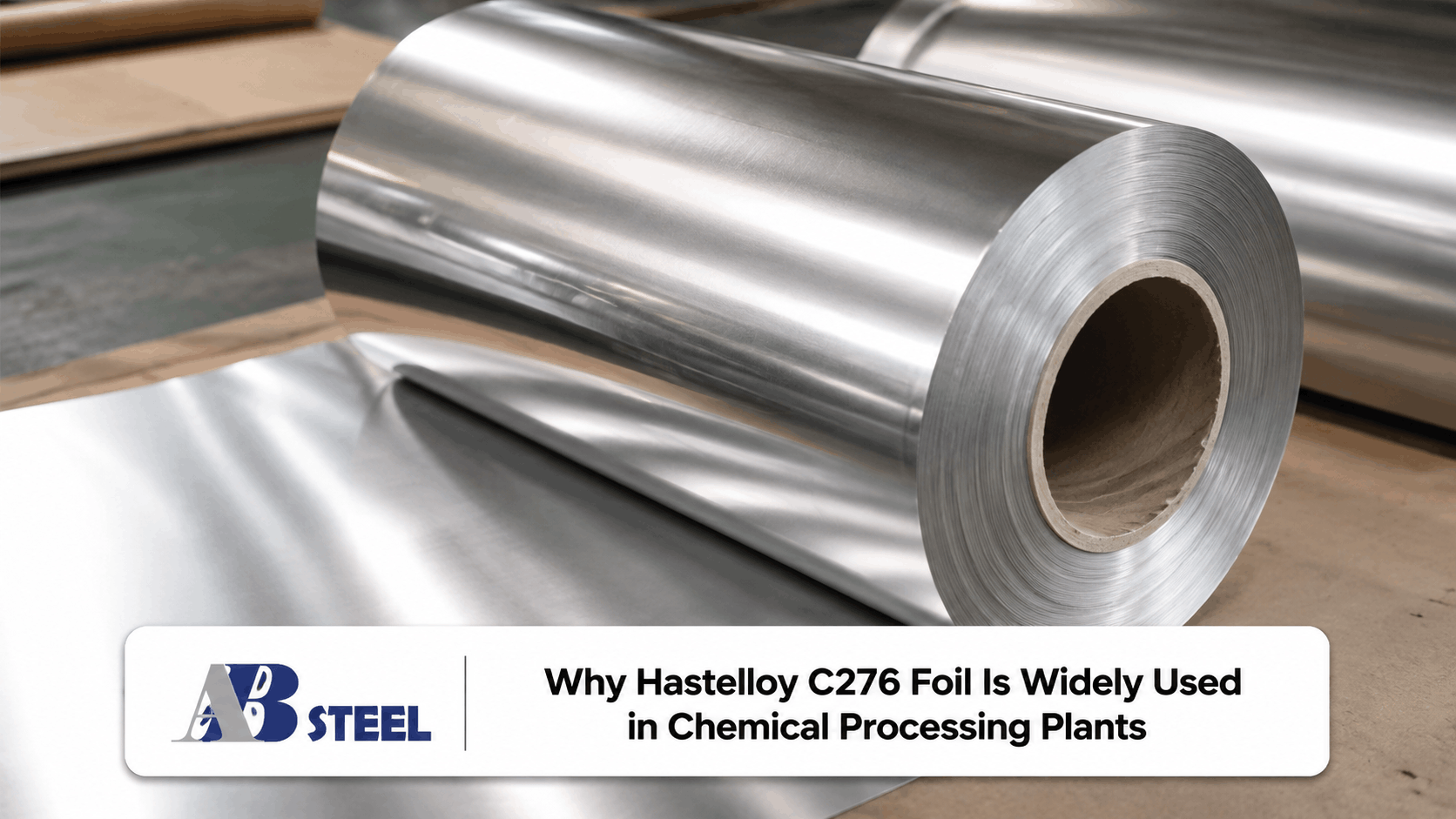
Hastelloy C276 carries 14.5 to 16.5 % chromium, 15 to 17 % molybdenum, and 3 to 4.5 % tungsten in a nickel base. That pairing resists both oxidizing and reducing environments, a rare combination in one alloy. Manufacturers roll this composition into foil from 0.001 inch to 0.01 inch thick, thin enough for gaskets and flexible linings. Fabricators who stock stainless steel sheets, plates, and coils for corrosion-resistant builds can source Hastelloy foil through the same supply channel for chemical service work.
Key Material Properties of Hastelloy C276 Foil
Four properties separate Hastelloy C276 foil from ordinary corrosion-resistant metals. Each one addresses a distinct failure mode found in chemical processing plants, from acid attack on exposed surfaces to cracking under sustained mechanical and thermal load.
- Good resistance to corrosion in acid, alkali and chloride-containing media
- Excellent chemical stability under changing pH and oxidizing conditions.
- Superior mechanical strength at elevated service temperatures
- Good weldability and fabrication characteristics with minimal performance loss
Key Reasons Hastelloy C276 Foil Is Widely Used in Chemical Processing Plants
Five practical reasons explain why Hastelloy C276 foil shows up across chemical processing plants, tied to specific operating conditions.
Outstanding Resistance to Aggressive Chemicals
Oxidizing acids and reducing acids destroy most alloys through different mechanisms, yet Hastelloy C276 handles both. Chlorides and wet chlorine gas cause no measurable pitting.
Excellent Protection Against Localized Corrosion
Pitting and crevice corrosion attack welds and joints faster than uniform surface corrosion. It resists both and lowers the risk of stress corrosion cracking under chloride load.
Reliable Performance at Elevated Temperatures
Sustained heat pushes ordinary alloys toward oxidation or creep failure. It keeps mechanical integrity through repeated thermal cycling in reactors and distillation columns.
Long Service Life with Reduced Maintenance
Premature failure forces unplanned shutdowns and emergency component replacement. Years of continuous service leave this foil largely unchanged, lowering inspection frequency and ownership cost.
Easy Fabrication and Welding
During fabrication, this foil bends into gaskets and reactor components without cracking. TIG welding joins it cleanly, keeping corrosion resistance close to the base metal.
Applications of Hastelloy C276 Foil in Chemical Processing Plants
Hastelloy C276 foil shows up in four equipment categories wherever aggressive chemicals meet thin, formable metal barriers.
Chemical Reactors and Processing Equipment
Reactor vessels handling nitric acid or chlorinated solvents rely on foil linings to prevent wall thinning at welds.
Heat Exchangers
Heat exchangers carry acidic fluid on one side and cooling water on the other. It resists corrosion at that interface without added coatings.
Storage and Containment Systems
Storage tanks and liners holding concentrated acids need protection against chemical attack. Foil linings extend service life beyond standard stainless liners.
Seals, Linings, and Barrier Components
Gaskets and barrier linings at pipe joints face repeated chemical and thermal cycling. Hastelloy foil holds its shape and seal integrity through thousands of cycles.
Performance Benefits of Using Hastelloy C276 Foil
Plants that switch to Hastelloy C276 foil report measurable gains in five performance areas, from daily uptime to long-term operating cost.
- Operational reliability rises because the foil resists common corrosion failure mechanisms.
- Corrosion resistance stays consistent across oxidizing acids, reducing acids, and chlorides.
- Equipment lifespan extends past what carbon steel or standard stainless components deliver.
- Maintenance schedules stretch out as inspection intervals lengthen and replacement grows less frequent.
- Process safety and efficiency both improve when barrier materials resist sudden leaks.
Factors to Consider When Selecting Hastelloy C276 Foil
Operating temperature sets the starting point for any foil selection, since sustained heat changes long-term mechanical behavior. Chemical compatibility with the process media matters just as much. Concentration, pH, and chloride content affect service life differently.
The thickness of the foil and the dimensional tolerance should be appropriate to the application, from a light gasket layer to a heavier lining sheet. The fabrication requirements, including bend radius and weld method, should be compatible with compliance to ASTM B575 or an equivalent industrial standard before ordering.
Conclusion
Hastelloy C276 foil remains a preferred material for chemical processing plants because it combines corrosion resistance, thermal stability and durability few alternative alloys match. Selecting the correct specification, based on real process conditions, protects equipment performance and keeps operations safe over years of service. AB Steel supplies corrosion-resistant metal products for industrial processing applications.